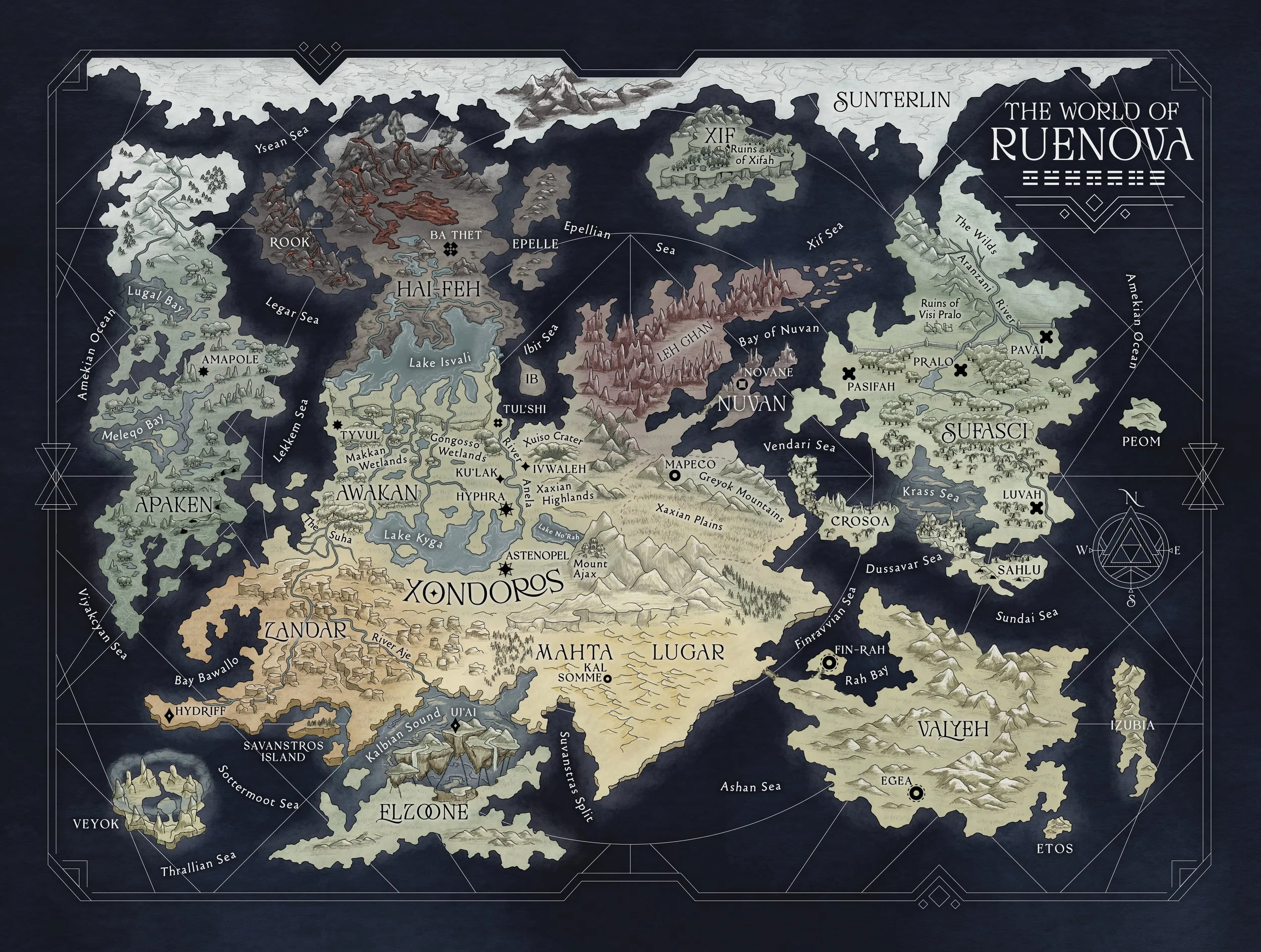

Ruenova did not wait for humanity. It had already been here for hundreds of thousands of years before the Arce IX landed — a refugee spacecraft carrying the last of a dead world's population, arriving on terms it did not set, into a civilization it had no map for.
The planet has its own memory. Not as record-keeping, the way archives work, but as something more fundamental: woven into the leylines that run beneath its surface, into the Val structures that grow at their convergence points across millennia, into the saltwater orbs the Meko people have used to seal lived experience in physical form since before humanity developed writing. Every species here has been shaping and being shaped by this world for longer than human history stretches in any direction.
The Great Walks — the Meko, the Lef, the Azo, the Veiga, the Arillea, and the peoples beyond them — did not emerge in a vacuum. They emerged through centuries of relationship with Ruenova's energy systems, each developing their own form of Invorio, their own connection to the sicma that moves through the planet's core.
Humans have none of this. They arrived with almost nothing and have spent the 577 sun cycles since trying to earn the right to remain.
That context is what Strange Faetes is built inside. Not a frontier to be claimed, not a world waiting to be discovered. A world that was already whole, already ancient, already watching — into which one species arrived late and uninvited and is now, for reasons the planet's oldest powers did not anticipate, becoming impossible to ignore.
Memory is political on Ruenova. History is the longest weapon anyone carries. And someone has been working for centuries to control both.
Welcome to Ruenova
"What is recorded persists. What is not recorded is not lost — it is taken from you before you know to hold it."
— Ue Vra, Xonne sage. Final ahika orb, unsealed posthumously.